

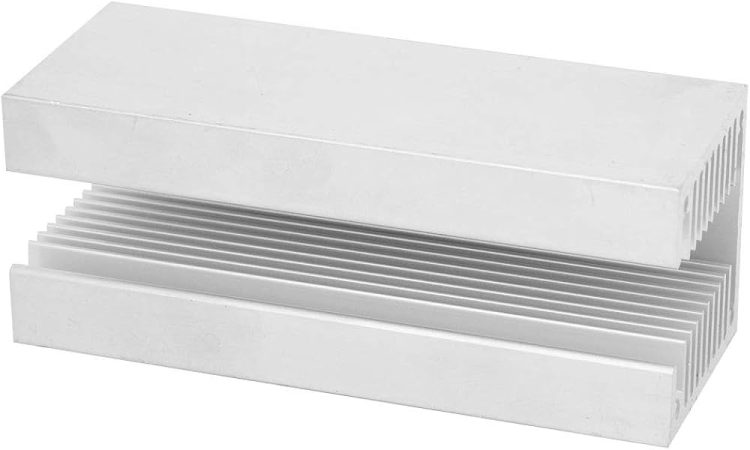

Tungsten heat sink versus copper represents not simply a choice between two metals but a decision about which set of engineering trade-offs best serves a particular application’s requirements. The question of which offers better cooling doesn’t yield to simple answers because “better” depends entirely on the context in which these materials operate. Copper conducts heat more efficiently in isolation, yet tungsten often provides superior thermal management in real-world systems. Understanding why requires examining not just thermal conductivity but the entire constellation of properties that determine long-term cooling performance.
Thermal Conductivity Fundamentals
The numbers appear straightforward at first glance. Copper conducts heat at approximately 400 watts per metre-kelvin at room temperature, making it one of the best thermal conductors among practical engineering materials. Tungsten manages only 173 watts per metre-kelvin, less than half copper’s conductivity. By this metric alone, copper wins decisively.
Yet this comparison tells an incomplete story. Thermal conductivity measures how quickly heat moves through a material under steady-state conditions. Real applications rarely operate under steady-state conditions. Power loads fluctuate. Electronics switch on and off. Operating environments change. The tungsten heat dissipation characteristics that matter most emerge not from conductivity alone but from how the material responds to dynamic thermal loads over extended periods.
The Density and Thermal Mass Factor
Copper weighs 8.96 grammes per cubic centimetre. Tungsten packs 19.3 grammes into the same volume, more than twice as dense. This density creates thermal mass that fundamentally changes how the material manages heat in transient conditions.
When a power surge hits a semiconductor device, a copper heat sink begins conducting that energy away immediately. Its high conductivity spreads the heat quickly, but the relatively low thermal mass means temperatures can spike before the cooling system responds. A tungsten heat sink absorbs the same energy surge with less dramatic temperature increase because of its greater heat capacity per unit volume. The material acts as a thermal buffer, smoothing temperature excursions that can stress or damage sensitive components.
Singapore’s Tungsten heat sink manufacturers exploit this property in applications where thermal transients pose reliability risks:
- Pulsed laser systems switching on and off in microseconds
- RF amplifiers handling rapidly varying signal loads
- Power semiconductors in switching converters cycling at high frequencies
- Automotive electronics subjected to ignition transients and load dumps
- Medical equipment where consistent temperatures ensure reliable performance
Thermal Expansion and Lifetime Reliability
The most significant difference between these materials often has nothing to do with heat transfer and everything to do with mechanical stability. Copper expands at 16.5 parts per million per degree Celsius. Tungsten expands at 4.5 parts per million, less than one-third as much.
This difference becomes critical at the interface between heat sink and semiconductor. Gallium arsenide expands at 5.7 parts per million per degree Celsius. Silicon carbide sits at 4.0. Gallium nitride measures approximately 5.3. When copper bonds to these materials, every thermal cycle creates mechanical stress at the interface. Solder joints fatigue. Bond layers delaminate. Over thousands or millions of cycles, these stresses cause failures that copper’s superior conductivity cannot prevent.
Tungsten thermal management solutions avoid this problem through thermal expansion matching. The close coefficient match between tungsten and common semiconductor materials prevents the interface stresses that limit copper’s lifetime in cycling applications. For electronics that must operate reliably for years or decades, this advantage often outweighs copper’s conductivity benefit.
Weight and Size Considerations
Applications with strict weight limits typically favour copper or aluminium over tungsten. Aerospace systems, portable electronics, and mobile equipment all benefit from lighter materials. Yet tungsten’s density becomes advantageous when space rather than weight constrains design.
A tungsten heat sink can pack more thermal mass into limited mounting area than copper. When circuit board real estate proves scarce or when components must fit within tight envelopes, tungsten’s compact thermal performance justifies the weight penalty. The material allows designers to achieve necessary thermal management within dimensional constraints that would defeat lower-density alternatives.
Cost and Manufacturing Reality
Copper costs less per kilogramme than tungsten, both as raw material and in processing. Copper machines more easily, accepts conventional tooling, and can be formed through various manufacturing methods. These factors make copper the default choice for most thermal management applications.
Tungsten requires powder metallurgy, specialised machining, or electrical discharge machining for complex shapes. Tool wear runs higher. Processing times extend longer. These manufacturing realities translate to higher component costs that matter significantly in consumer products or other cost-sensitive applications.
Singapore’s Tungsten heat sink industry addresses these cost concerns through manufacturing expertise and economies of scale in specific sectors. The premium price becomes justified when thermal cycling lifetime, dimensional stability, or compact thermal mass determine system reliability and total cost of ownership.
Hybrid Approaches
Recognition that neither material optimally serves all requirements has driven development of copper-tungsten composites. These materials combine 70 to 90 per cent tungsten with copper infiltrated into the porous structure. The resulting composite offers:
- Thermal conductivity between pure tungsten and pure copper
- Expansion coefficients tailored to specific applications
- Cost and weight between the two pure materials
- Design flexibility for optimising specific parameters
The Practical Answer
Neither material universally provides “better” cooling. Copper excels when thermal conductivity matters most, when weight proves critical, or when cost constraints dominate design decisions. Tungsten heat sinks serve applications where thermal cycling lifetime determines reliability, where compact thermal mass enables space-constrained designs, or where thermal expansion matching prevents interface failures. The choice depends not on material properties in isolation but on how those properties interact with specific application requirements, operating conditions, and lifetime expectations. Understanding this context separates effective thermal design from simple material selection, making the question of copper versus Tungsten heat sink one that engineers must answer based on their particular circumstances rather than universal principles.